




Welcome to the Hive
A Dermatologist Explains Why Intimate Skin Is the Most Overlooked Skin on Your Body
When you think of skincare what comes to mind? Be real with me, you just thought of your face didn’t you? As a board-certified dermatologist I can attest that the most overlooked skin is that of the intimate area. While most recently there’s even been the “skin-ification” of the scalp, where scalp skincare has taken a front seat, unfortunately our most sensitive area is still being neglected. Our intimate areas get the leftovers of whatever we use for our bodies.
The intimate skin is different from the rest of our body because there are fewer layers to the epidermis (top layer of skin), less oil glands, and mucosa (soft pink moist tissue) is present. The intimate areas are also most likely to be covered in clothing items almost constantly. These structural differences make intimate skin significantly more vulnerable to irritation, imbalance, and infection than skin elsewhere on the body. Because there are fewer protective layers and less sebum (the skin's natural moisturizing barrier), the area is more easily disrupted by harsh ingredients, friction, and moisture.
Caring for intimate skin therefore requires ingredients that are not only effective but specifically chosen for their gentleness and ability to support the skin's natural defenses.
Lavender and lemon balm are both soothing and anti-inflammatory. Lavender oil has been used since ancient times in topical formulas for its fragrance and wound healing properties. The components of lavender oil are known to be anti-microbial and anti-fungal, meaning they target microorganisms and fungus on the skin. Lemon balm is an herb that has been used in both the medical and cosmetic industries. The extracts of lemon balm are known too for its antimicrobial, antiviral and antifungal properties. It is also soothing and anti-inflammatory. These properties of lavender and lemon balm contribute to less inflammation by maintaining a healthy skin microbiome by reducing virulent strains of bacteria and fungus that may lead to rashes, irritation and discomfort, which makes them excellent products for sensitive areas.
You might recognize the next ingredient from your wellness shelf, but ashwagandha does far more for your skin than you may know. Ashwagandha is a shrub useful for a myriad skin and systemic disorders; however, you may be more familiar with it as an adaptogen. In the skin it decreases trans-epidermal water loss (TEWL) and enhances skin hydration and skin elasticity. By reducing TEWL and increasing the hydration of skin, a user will notice less irritation and dryness.
True intimate skin care doesn't stop at what you put on your skin, it extends to what your skin is in contact with for hours at a time.
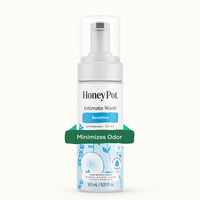
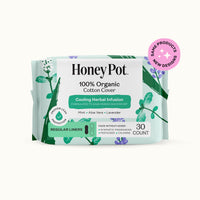
Organic cotton is the superior to synthetic materials when it comes to sensitive skin of the intimate area. Synthetics are often occlusive, increasing skin moisture and inviting microbes to flourish, and synthetics may contain chemicals such as formaldehyde and dyes. The Honey Pot’s calming pads have organic cotton as the top layer, which will decrease sensitivity, irritation and possible allergy. This gentle cotton layer and the botanicals lavender, lemon balm and Ashwagandha are the soothing ingredients you’ll experience in The Honey Pot’s calming wash and pads.
The taboos surrounding intimate skin hasn't served us well cultural stigma means most people never learned how to care for this area and are often too embarrassed to ask. While the vagina has its own built-in cleaning system, the vulva is not and requires the same thoughtful attention we give the rest of our skin.
Now you can rethink skincare and include those most forgotten areas. If you’d like to tap into more self-care I encourage you to join The Honey Pot Company’s Reclaiming Wellness community to foster and feed not only your physical self, but your mind and soul as well.
Citations
-
Białoń, M., Krzyśko-Łupicka, T., Nowakowska-Bogdan, E., & Wieczorek, P. P. (2019). Chemical Composition of Two Different Lavender Essential Oils and Their Effect on Facial Skin Microbiota. Molecules, 24(18), 3270. https://doi.org/10.3390/molecules24183270
-
Meher, D. S. Uses of Withania somnifera (Linn) Dunal (Ashwagandha) in Ayurveda and its Pharmacological Evidences. https://doi.org/10.5958/2321-5836.2016.00006.9
Keep reading


